Concepts
Overview of this Document
This document covers basic concepts of Radius, 802.1x and PacketFence.
RADIUS is very complicated and this document attempts to help break down the concepts for better understanding.
This document explains:
- The flow of a RADIUS request from start to finish
- PacketFence Behavior
- RADIUS concepts
- 802.1x concepts
- Use-cases for certain features and when not to use them
- Terms and Definitions
- Intended to get a basic grasp on the overall process
This document is NOT:
- Technical documentation
- Direct configuration examples
- 100% accurate (this is my loose understanding verified by trial and error, document interpretation, and AI)
- Complete (I missed some details most likely)
The Monkey drop downs are a TLDR that explain it as simply as possible.
I find them extremely useful at times for complicated processes like this to get a start on understanding how parts interact or when I am trying to go fast and need the quick rundown.
The FreeRadius documentation was used for referencing and verifying this information. Its strictly documentation for FreeRadius so it doesn't exactly apply to PF especially for configuration. However, as PF uses FreeRadius under the hood it is very useful for understanding some of the concepts of RADIUS. The PF documentation is useful for configuring examples but I found it lacking in explanations.
PacketFence Purpose
The primary principle of RADIUS and 802.1x as a whole is to secure a network (wired or wireless) with authentication steps to prevent anyone with a RJ45 cable to connect to network.
PacketFence (PF) is a wrapper as well as provides extra features for FreeRadius. It provides a UI that is used to manage FreeRadius modules but does not map 1 to 1 with FreeRadius config settings. It is abstracted a layer above to make management easier. Much of the flow of FreeRadius is managed by PacketFence and handled automatically so it can be tricky to understand how settings link together.
Network RADIUS Requests
The flow starts when a device tries to connect to the network either by a switch port or connecting to an Access Point SSID. Both the switch and AP are refered to as a "NAS" (Network Access Server). The device attempting to connect is referred to as the Node. When a node connects to a NAS initially the NAS will essentially proxy requests to the RADIUS server to verify AAA (Authentication, Authorization, Accounting).
There are 2 main ways
Monkey
AP/Switch = NAS
client device or watever is trying to connect = Node
packetfence is the radius server
- node asks nas for access
- nas asks radius based on the node info
- radius tells the nas yes/no
- nas allows or denies the node
802.1X Networks
When a port is set to 802.1X or it is an Enterprise SSID, EAP is REQUIRED before the NAS allows the node on the network at all. This means special configuration on the connecting device is mandatory.
The node sends EAPOL (EAP over LAN) frames to the switch at link-up. The switch strips the EAP payload, wraps it in a RADIUS Access-Request, and relays it to the RADIUS server. This is the full inner/outer tunnel flow described below. The node itself must have an 802.1X supplicant which most every modern network PC or phone has.
This is very strict.
802.1X operates at Layer 2 (data link / MAC layer). The switch port is in an unauthorized state before auth completes. It doesnt pass any traffic except EAPOL frames. No ARP, no DHCP, no IP at all.
The issue with this is that it requires extra configuration on the Nodes end meaning that unless the device is a managed device where configuration can be pushed out by policy, this will be a lot of extra work setting up each device as this will be too complex for most customers.
Use Cases:
- High security networks
- 802.1x switch port profiles
- WPA2/WPA3-Enterprise wireless networks
- All devices are managed for policy deployement
- Customer is able to configure the connection themselves (unlikely
Monkey
network is very strict
no access not even dhcp or ip address until radius tells the NAS to
MAC Authentication Bypass
Some ports are set to MAB for devices that cant run a supplicant or for networks where configuring the node is too difficult. The switch detects a connection, grabs the nodes MAC address, and sends a plain RADIUS Access-Request with the MAC used as both username and password. No EAP, no TLS tunnel, no inner method. The server checks the MAC against a whitelist and either accepts or rejects it. Common for printers, IP phones, cameras, IoT or open networks where you the node is put onto an isolation VLAN to further authorize on a web portal or other method.
Use Cases:
- Low security networks (eg Guest wifi)
- Devices that do not support 802.1x
- Networks where you want to do more advanced VLAN assignment
Monkey
device joins network
nas gets the MAC address as the login for radius
insecure as MACs are easy to spoof
good for when you want further authentication past MAC but just want easy network access up front
useful for devices with bad network capability
EAP
802.1x uses the EAP standard for authentication. This section describes the process of an EAP request. This is important to understand for when you configure PF.
The FreeRadius Docs have better breakdown for more in depth details.
The Extensible Authentication Protocol (EAP), RFC 3748, is an authentication framework and data link layer protocol that allows network access points to support multiple authentication methods. Each EAP Type indicates a specific authentication mechanism. The 802.1X standard authenticates both wireless and wired LAN users/devices trying to access Enterprise networks.
There are essentially there are 2 components used for the standard implementation of EAP, Outer Tunnel and Inner Tunnel. Depending on what type of EAP your using typically the NAS is able to see all of the information in the Outer Tunnel. This usually includes unimportant information like an arbitrary Identity (such as anonymous@domain) and other identifying attributes. Everything in the Inner Tunnel is encrypted with TLS and only visible to the RADIUS server.
Monkey
EAP is how radius NAS and node talk on 802.1x
Not used in Mac Authentication Bypass (MAB)
only used in the initial join on a 802.1x network
outer EAP tunnel = basic info visible to NAS
inner EAP tunnel = encrypted info only for RADIUS
Outer Tunnel
The outer tunnel is the encrypted wrapper. When a node connects, the NAS sends an Access-Request to the RADIUS server. The server replies with an Access-Challenge asking for an EAP identity. This kicks off an EAP handshake carried through the NAS, which is just passing packets back and forth between the node and server without inspecting them. The outer tunnel establishes a TLS session between the node and the RADIUS server. The NAS is blind to this traffic it just relays EAP frames.
Common outer methods/implementations of EAP are:
PEAP:
- Protected EAP
- Basic inner tunnel wrapped in TLS
Usually highly compatible with all devices
EAP-TTLS:
- Tunneled TLS
Essentially EAP inside of EAP.The inner tunnel for EAP-TTLS can be most any EAP method or a standard inner tunnel methodMainlyUsuallysupportedhighlybycompatiblenewerwithdevices.all devices- Typically not used by default so it works a little less out of the box but all EAP connections usually require manual configuration anyways.
EAP-TLS:
Inner Tunnel
Inside the encrypted TLS session, the actual authentication happens. The outer tunnel already established trust (the server proved its identity with a certificate), so the inner method can send credentials in cleartext inside that protected channel.
Common inner methods inside PEAP/TTLS:
MSCHAPv2 username + NT hash challenge-response:
- Used for Domain accounts against a Domain controller
- A good option for domain Windows PCs
PAP plaintext username/password inside the tunnel:
- Used for Accounts against LDAP
- Good for domain managed devices if using LDAP against a DC
- Preferred as LDAP is more versatile for checking account attributes such as group or OU membership
EAP-GTC generic token card, one-time passwords:
The RADIUS server receives the inner credentials, checks them against its user store LDAP, local DB, Active Directory, and sends back an Access-Accept or Access-Reject through the NAS to the node.
Full Flow Example PEAP-MSCHAPv2MSCHAPv2:
Node connects to NAS switch port or SSID
NAS sends RADIUS Access-Request to server
Server sends Access-Challenge start TLS
NAS relays challenge to node
Node and server negotiate TLS certificate validation
TLS tunnel established NAS is still just passing bytes
Inside the tunnel node sends username
Server challenges node for password hash
Node responds with MSCHAPv2 response
Server verifies against AD/LDAP
If valid server sends Access-Accept with attributes VLAN ID, QoS policy, session timeout
NAS applies those attributes to the port/association
Node gets network access
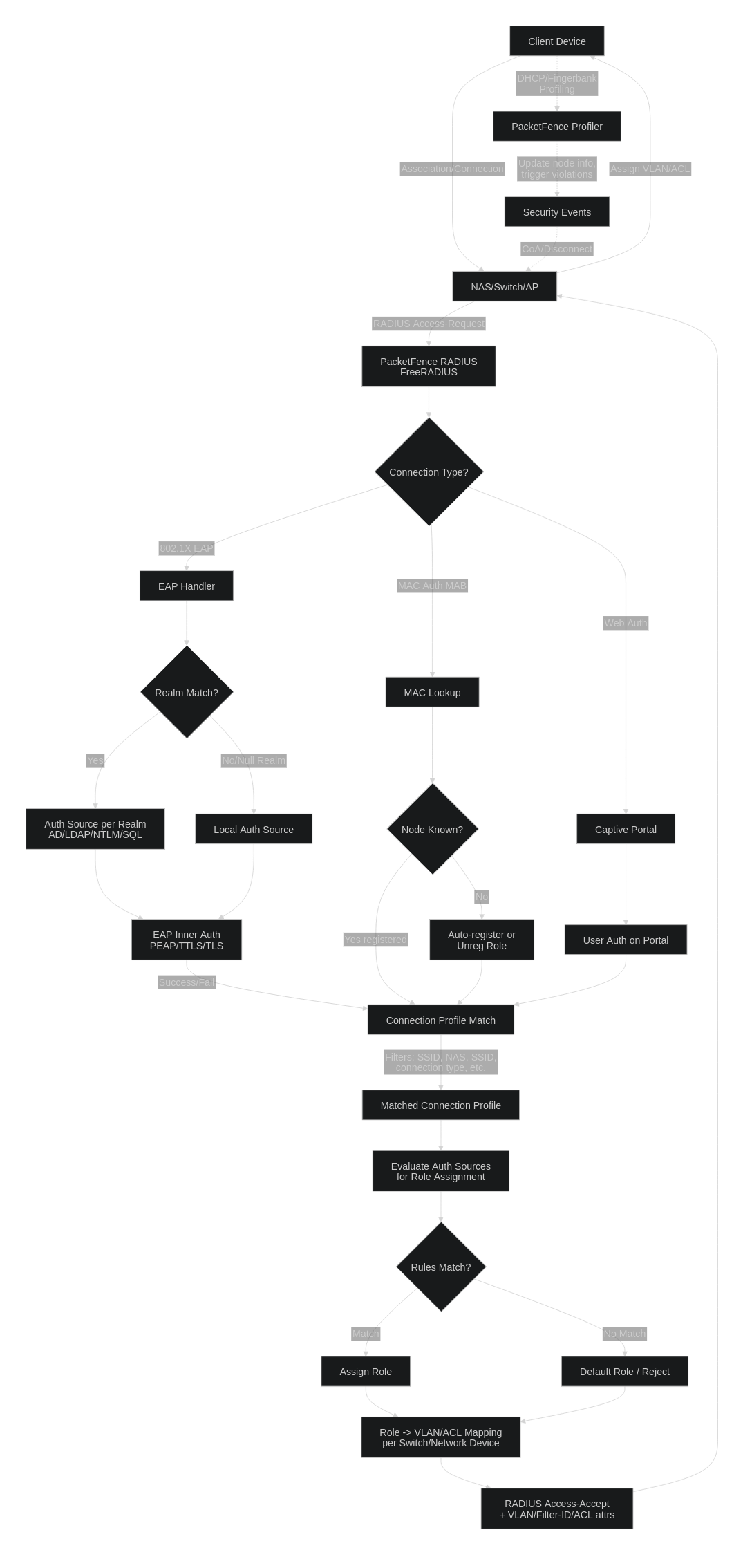
Flow of a Request Inside of Packetfence
PF takes incoming RADIUS requests from a NAS (switch, AP, or controller) and processes them through a defined chain before returning an Access-Accept/Reject with VLAN or ACL attributes. The stages below run in order for every authentication attempt.
Flow Chart at the bottom of the page
1. RADIUS Request Arrival
The NAS sends an Access-Request to PacketFence's FreeRADIUS instance when a client associates or plugs in. The request type determines the auth path:
- 802.1X (EAP) — used by WPA2/WPA3-Enterprise SSIDs and wired dot1x.
- MAC Authentication (MAB) — used for open SSIDs or non-802.1X-capable devices (printers, IoT).
- Web Auth — client is redirected to the captive portal for credential entry.
2. Realm Resolution (EAP only)
For EAP requests, PF parses the username (e.g. user@realm or DOMAIN\user) and matches it against the Realms configuration. The realm determines which Authentication Source handles the outer/inner EAP exchange (AD via NTLM, LDAP with PAP, SQL, etc.). A null or unmatched realm falls through to the default/local source.
3. Authentication
- EAP: Inner method (PEAP-MSCHAPv2, EAP-TTLS, EAP-TLS) is negotiated and validated against the realm's auth source.
- MAB: The client MAC is looked up in the PF node database. Known/registered nodes proceed; unknown nodes are auto-registered or assigned the unregistered role depending on the connection profile.
- Portal: User submits credentials on the captive portal, which are validated against the portal's configured auth sources.
4. Connection Profile Matching
PF evaluates Connection Profiles top-down using filters (SSID, NAS IP, connection type, VLAN, realm, etc.). The first profile whose filters match the request wins. The connection profile dictates which auth sources are consulted for role assignment (this is separate from the EAP auth source used in step 2/3).
5. Role Assignment
The matched profile's auth sources are evaluated in order. Each source contains rules that compare attributes (group membership, username, MAC, time of day, etc.) and assign a role on match. If no rule matches, the default role for the profile is used, or the request is rejected.
6. Role → Network Enforcement Mapping
The assigned role is translated into concrete RADIUS reply attributes per the Switch/Network Device configuration. Each switch entry maps roles to:
- VLAN IDs (
Tunnel-Private-Group-ID) - Filter-IDs or downloadable ACLs
- Vendor-specific attributes (Unifi, Cisco, Aruba, etc.)
7. Access-Accept Returned
PF sends the Access-Accept with the role's attributes back to the NAS, which places the client on the correct VLAN and applies any ACLs.
8. Profiling & Security Events (Parallel)
After the session is up, PF passively collects DHCP fingerprints, user-agent strings, and other telemetry, sending them to Fingerbank for device profiling. Profile changes or triggered Security Events (violations) can fire a RADIUS CoA / Disconnect to the NAS, forcing reauthentication and a new role assignment mid-session — this is how PF quarantines or reclassifies devices without admin intervention.
Flow Chart: